
Build vs buy
Build vs Buy: The Real Cost of an In-House AI Investment Research Platform
10 min read
AI has changed what investment teams expect from their research management system (RMS). Analysts want to search years of investment research and meeting notes in seconds. Fund selectors want manager reviews and performance data side by side. Investment committees want house views pulled together and ready to challenge.
With demand like that, many firms are weighing up build vs buy: should we develop an AI investment research platform in-house, or buy one?
Building in-house can look attractive. You get full control, a tool shaped around your process and no reliance on a vendor. But most build estimates price a single platform for a single team. In practice, every 5 to 10 person team needs its own version, the technology needs constant upkeep, and your best people get pulled into the project. Below we cost it out, line by line, and set it against what The Stream actually charges.
We look at it through five lenses: cost efficiency, delivery risk, innovation, speed to deployment and keeping your people focused on alpha. Then we explain why modern AI platforms can be shaped around your team in a way older research tools never could.
How much does it cost to build an AI investment research platform?
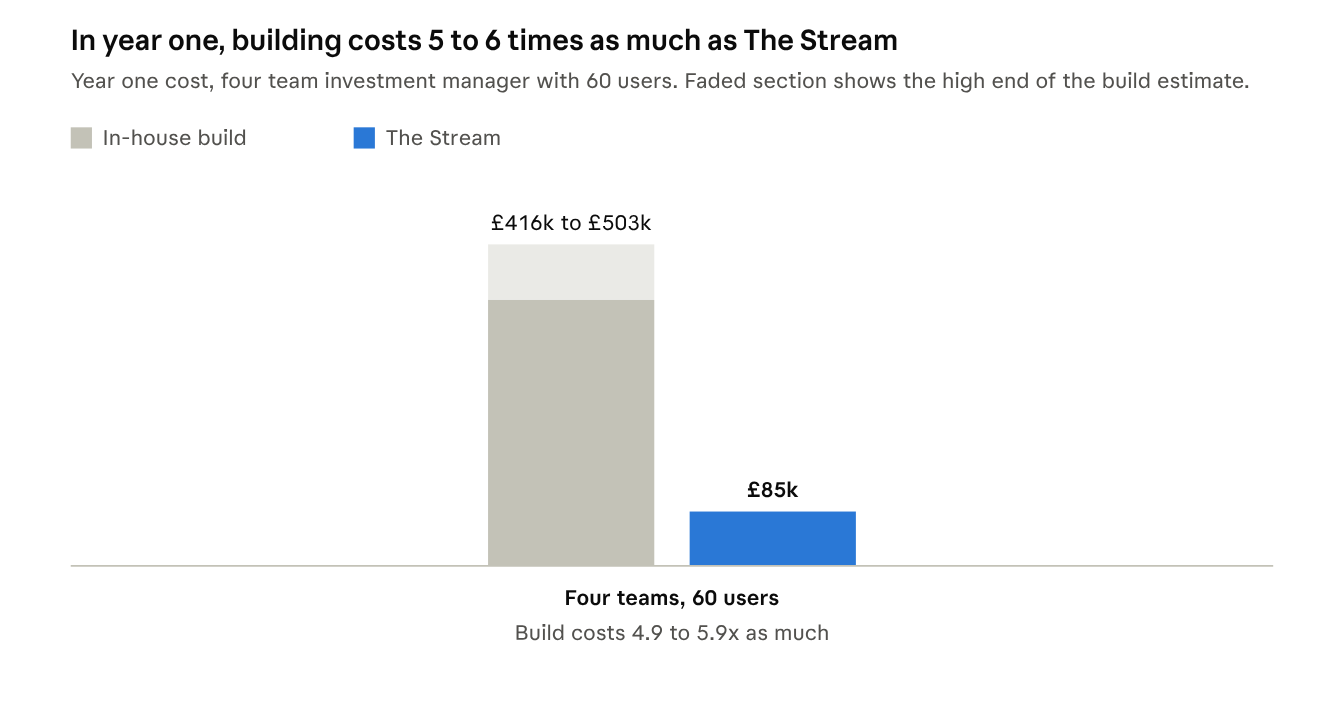
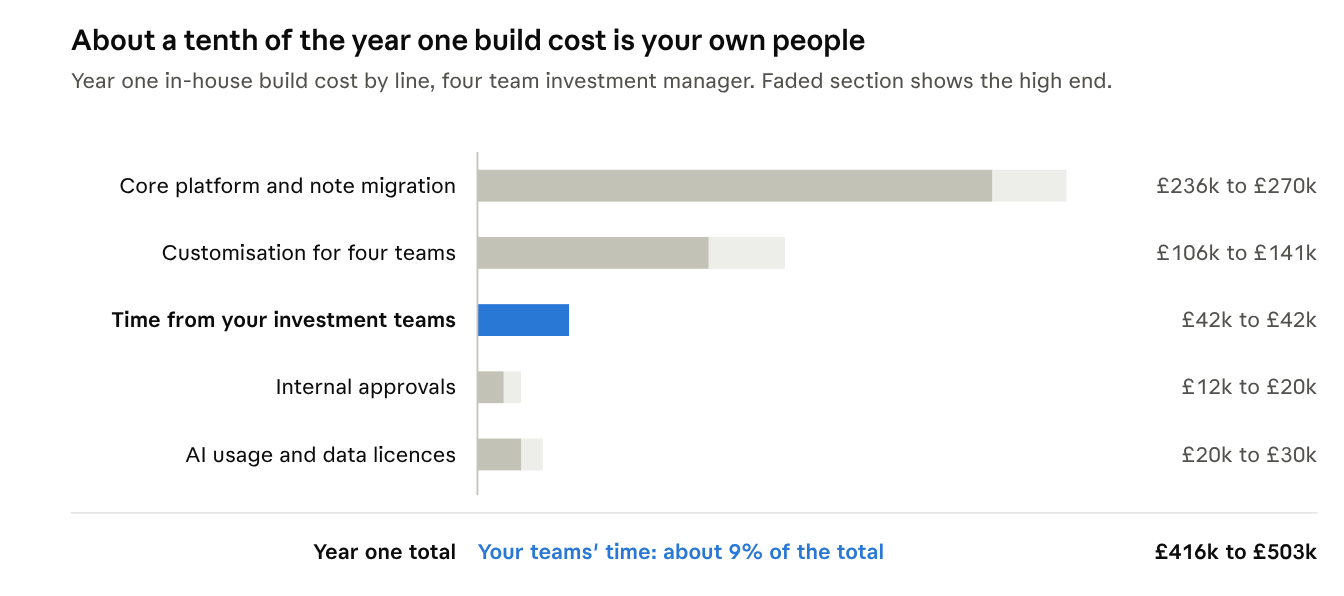
For a typical investment manager with four research teams, an in-house build costs £416k to £503k in year one. That covers developers, project management, migrating historical notes, internal approvals, AI usage and data licences. The same firm would pay The Stream £85k a year. In other words, the build swallows 5 to 6 years of our platform fees just to get off the ground.
Our example firm. Throughout this post we model an investment manager with 30 editing users across its research teams and 30 view only users in client facing roles. On The Stream, that typically comes to around £85k a year, with everything included.
What does the core platform cost?
Every build starts with a shared foundation: secure logins and permissions, a document store, search, an AI layer that can read your research, and connections to your data. None of this is visible to users, but nothing works without it.
We've costed it at the median London contract rate of £550 a day (IT Jobs Watch). Specialist agentic AI engineers command more, with a median of around £575 and the top 10% above £700 (IT Jobs Watch), so this is a conservative starting point.
| Workstream | Days | Cost at £550 a day |
|---|---|---|
| Scoping, discovery and project management | 40 to 45 | £22k to £25k |
| Design and user experience | 18 to 22 | £10k to £12k |
| Core application: interface, permissions, audit trail, document store, search | 150 to 170 | £83k to £94k |
| AI layer: document ingestion, retrieval, prompts, accuracy testing | 70 to 80 | £39k to £44k |
| Core data connections (CRM, market data, document sources) | 35 to 40 | £19k to £22k |
| Migrating historical notes and documents: extracting from email, shared drives and old systems, cleaning, tagging and checking | 25 to 35 | £14k to £19k |
| Infrastructure: environments, deployment, monitoring, backups | 18 to 22 | £10k to £12k |
| Testing and QA | 45 to 50 | £25k to £28k |
| External penetration test and security review | Fixed fee | £15k |
| Total | 401 to 464 | £236k to £270k |
That is 18 to 21 months of one developer's time.
Then there are the internal approvals. An in-house AI platform holding investment research needs a business case, an IT architecture review, information security sign off, a data protection impact assessment, AI governance and model risk review, and compliance approval. We estimate 15 to 25 days of senior time across IT, risk, legal and compliance, around £12k to £20k, and often several months of elapsed time before a line of code is written.
Why does each investment team need its own version?
This is the cost most business cases miss. An equity team, a fund selection team and an ESG team do not work the same way. Each has its own templates, scoring frameworks, data sources and language, and the platform has to be shaped around each one.
| Work for each team | Days |
|---|---|
| Workshops and process mapping | 6 to 8 |
| Templates, note formats and scoring frameworks | 12 to 15 |
| Team specific data connections | 12 to 18 |
| AI prompts and workflows tuned to the team's language, plus accuracy testing | 12 to 15 |
| User testing, training and fixes | 6 to 8 |
| Developer cost (48 to 64 days at £550) | £26k to £35k |
| Your team's own time (around 13 days at around £800) | £10k |
| Total per team | £36k to £45k |
What does buying cost instead?
The Stream is a simple annual subscription, priced by the number of investment users, with lower cost access for view only users, who are typically client facing teams who need the latest house investment views and recommendations. Setup, team configuration, maintenance, security and AI usage are all included, so there are no build costs and no surprise bills.
Worked example: total cost for a four‑team investment manager
Take a firm with 30 editing users across its equity, fund selection and ESG teams, plus 30 view only users in client facing roles. A firm of this size would typically pay The Stream around £85k a year.
| Cost | Build in-house: year one | Build in-house: three years | The Stream: three years |
|---|---|---|---|
| Core platform, including migrating historical notes | £236k to £270k | £236k to £270k | Included |
| Customisation for four teams | £106k to £141k | £106k to £141k | Included |
| Your teams' time (two days a week for six months) | £42k | £42k | Minimal |
| Internal approvals: IT, security, data protection, AI governance, compliance | £12k to £20k | £12k to £20k | Due diligence handled by The Stream |
| AI usage, hosting and data licences during the build | £20k to £30k | £20k to £30k | Included |
| Running costs, years two and three (see maintenance costs below) | None | £254k to £330k | Included |
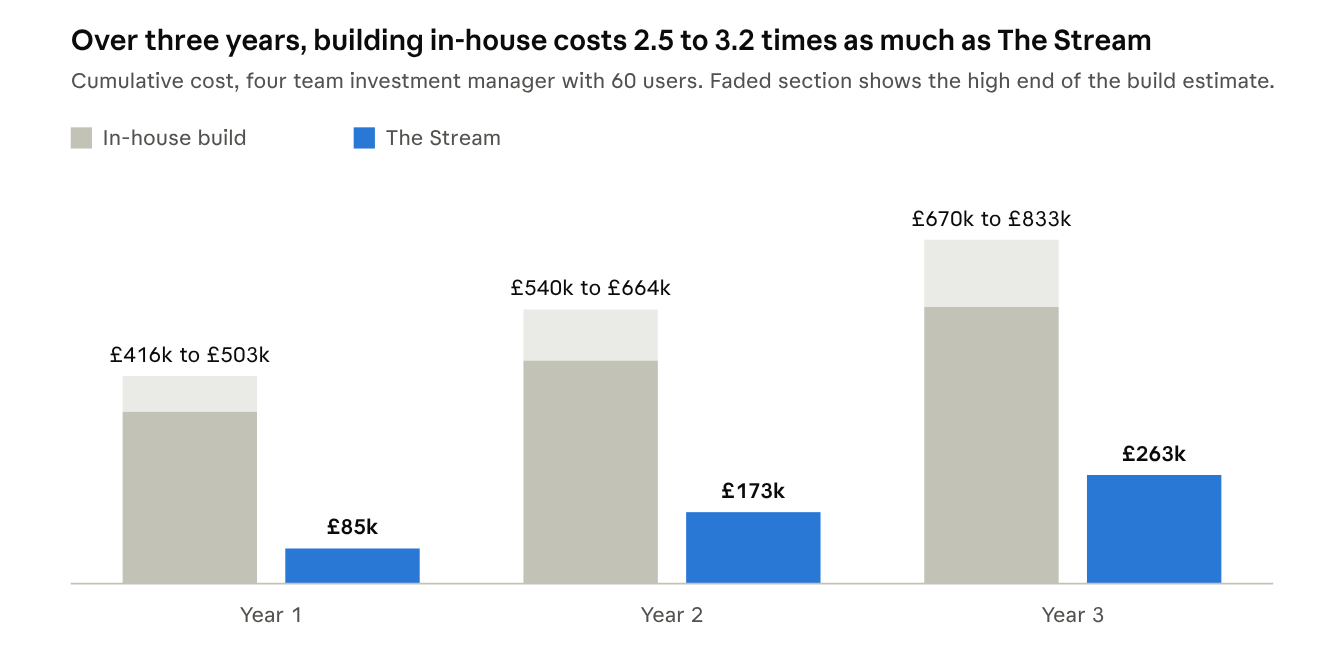
| Total | £416k to £503k | £670k to £833k | £263k |
Three year figures include a 3% yearly price rise for The Stream and 5% yearly growth in build running costs.
Over three years, that's a saving of roughly £405k to £570k. Per user, the build works out at £3.7k to £4.6k a year, against £1.5k on The Stream.
Even a firm building for a single 8 person equity team should expect £336k to £397k in year one, because the core platform and approvals cost the same whether it serves one team or four. On The Stream, a team that size would typically pay around £25k a year. The build would cover 13 to 16 years of subscription.
What are the chances an in‑house build actually delivers?
The costs above assume the build succeeds. Many don't. A large share of in-house technology projects never deliver what was promised, either at all or in large part, and AI projects fare worse than most:
- AI projects fail at twice the rate. RAND estimates that more than 80% of AI projects fail, twice the rate of technology projects that don't involve AI (RAND).
- Many never get past the pilot. Gartner predicted that at least 30% of generative AI projects would be abandoned after proof of concept by the end of 2025, because of poor data quality, weak risk controls, rising costs or unclear business value (Gartner).
- IT projects of every size under-deliver. A McKinsey and University of Oxford study of more than 6,000 public and private sector IT projects found that, regardless of size, they ran 75% over budget and delivered 39% less value than predicted on average (McKinsey).
A research platform build is smaller than the mega programmes behind many of these figures, and smaller projects do tend to fare better. But even a modest overrun pushes the year one cost towards or beyond half a million pounds. And if the project stalls, the money and your team's time are gone, with nothing to show for it.
A ready-made platform takes most of that risk off the table. The product already exists, it's already used by more than 60 investment firms, and our free two month pilot lets your team test it on its own workflows before committing anything.
How much does it cost to maintain an in‑house research management system?
Launch day is the start, not the finish. AI is moving faster than almost any other area of technology, and a tool built today can feel dated within a year. For the four team firm above, keeping an in-house platform current costs more each year than The Stream's entire subscription.
| Running cost | Per year |
|---|---|
| Platform maintenance: new AI models, security updates, bug fixes, support (around 20% of the core build; 15% to 25% is a common rule of thumb per Edana) | £47k to £54k |
| Team upkeep: template changes, new data sources, new workflows (£8k to £12k per team) | £32k to £48k |
| AI usage: Microsoft 365 Copilot for 60 users at £23.10 per user per month (Microsoft) | £17k |
| Hosting, search database and monitoring | £8k to £12k |
| Data licence uplifts for API and AI use | £20k to £30k |
| Total | £124k to £161k |
We've assumed the firm licenses its AI through Microsoft 365 Copilot, which many already use. That's around £17k a year for 60 users. Research work means long documents, follow up questions and accuracy checks, so heavier use may need extra AI capacity on top.
There's also key person risk. If the developer who built the system leaves, much of the knowledge goes with them, and replacing them is not quick.
Our subscription covers all maintenance, security and updates out of the box. When a better AI model is released, we test it and roll it out. Your teams get the improvement without a project, a budget request or a developer.
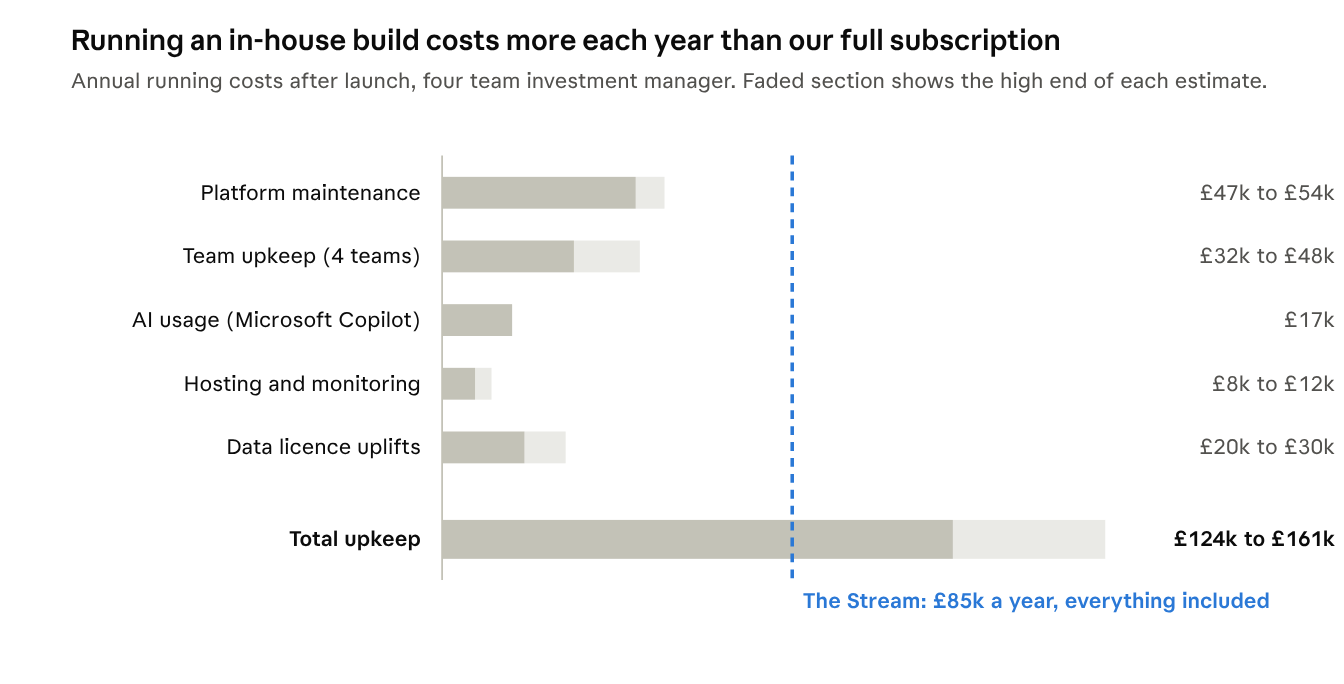
Because upkeep costs more than the subscription every year, the gap keeps widening the longer you run an in-house build.
Will the gap close over time?
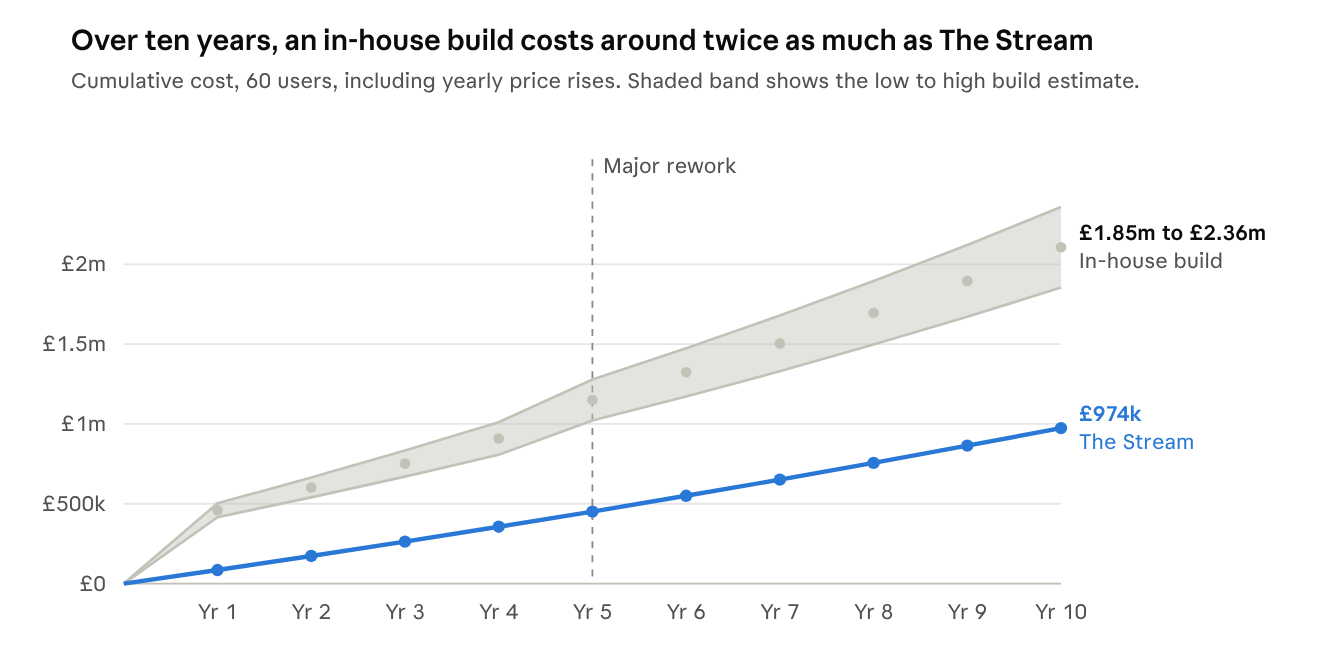
No. If anything, it widens. Neither option stands still on price, so the chart above assumes both rise:
- The Stream rises with your subscription. Like any software subscription, prices typically go up at renewal, and adding users or teams moves you into a larger band. We've assumed a 3% rise a year in line with guided inflation.
- An in-house build rises faster. Developer rates go up each year, ageing code takes longer to change, and every new team or data source becomes another project. We've assumed running costs grow 5% a year.
- AI moves fast. A tool built today will probably need a major rework within a few years as models and tooling change. We've assumed one in year five, at around 30% of the original platform cost (£71k to £81k).
- Licence costs keep climbing. Microsoft raised its Microsoft 365 prices in July 2026 (Microsoft), and data vendors increasingly charge extra for API and AI use.
The real difference is scale. A specialist provider spreads the cost of each new AI capability across all its clients, so each firm pays a fraction. An in-house team pays for every upgrade alone. The result is a subscription that stays predictable, against a build that tends to get more expensive the longer it runs.
How long does an in‑house build take?
A typical internal build takes 12 months or more from first scoping to a tool your team actually uses, and longer if teams are rolled out one by one. In the meantime, analysts carry on working across scattered notes, spreadsheets and inboxes, and the firm pays for the build without getting any value from it.
And 12 months is the plan. A McKinsey and University of Oxford study of more than 6,000 public and private sector IT projects found that, regardless of size, schedules overran by 46% on average (McKinsey). Applied to a one year build, that's around 18 months before your team has a working tool.
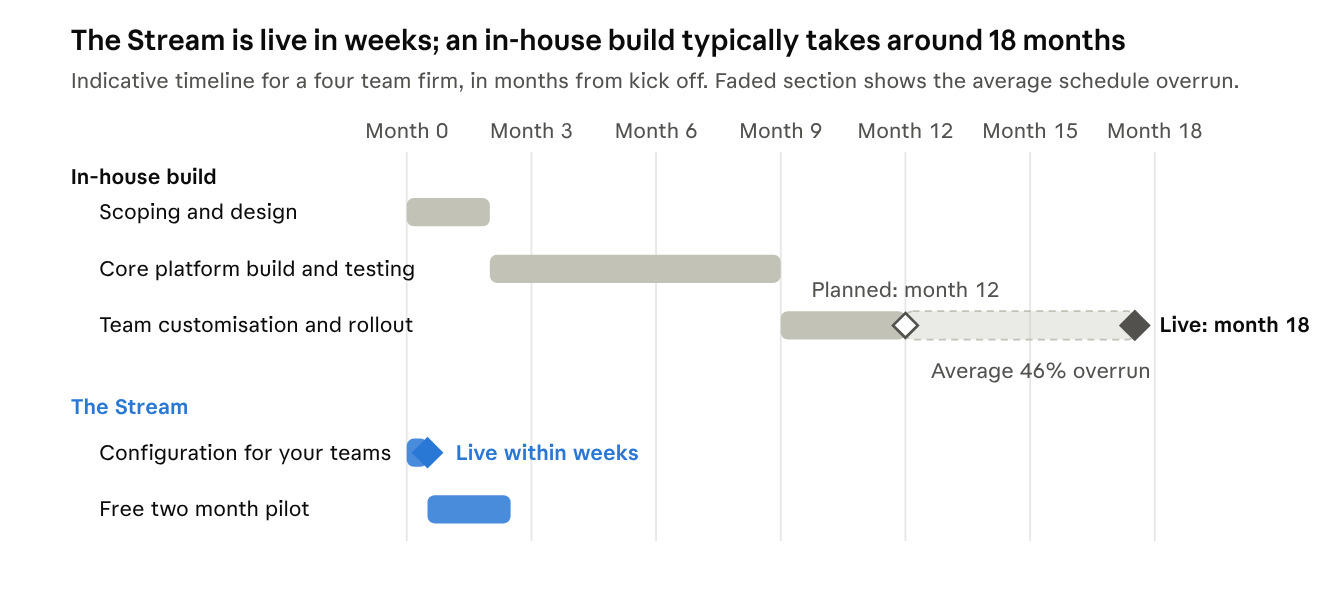
The Stream can be configured and in your team's hands within weeks. We also offer a free two month pilot, so your team can test the platform on its own workflows before committing a penny. An internal build gives you no way to try before you buy.
How much of your investment team's time does a build take?
The hidden cost of a build is your own people. In our example, investment professionals give up around two days a week for six months to write specifications, test features and answer developers' questions. That's time taken straight out of research, at exactly the point the firm is trying to get ahead.
That time doesn't stop at launch. Every new template, data source or change in process becomes a ticket, a meeting and a test cycle.
Investment firms win by generating better insight, not by becoming software companies. With The Stream, your team's input is limited to telling us how they work. We do the engineering, so your analysts, fund selectors and ESG specialists stay on research, portfolio decisions and clients.
Will a ready‑made research management system force us to change how we work?
This is usually the concern that pushes firms towards building. It's a fair one for legacy research tools, which were designed around a single standard workflow. Teams end up bending their process to fit the software, and any change means a feature request and a long wait for the vendor's next release.
Modern AI platforms are built differently, and that changes the build vs buy maths. They are far more customisable than legacy solutions because:
- Configuration replaces code. Templates, scoring frameworks, fields and workflows are set up as configuration, not hard coded. A new note format takes minutes, not a development cycle.
- AI understands your language. Large language models read unstructured notes, meeting transcripts and documents as they are. Your team doesn't have to fit its thinking into rigid database fields, and the AI can be tuned to each team's terminology.
- Modular, API first design. Modern platforms connect to your CRM, market data and document sources through standard APIs, so adding a data source is a connection, not a rebuild.
- Continuous delivery in the cloud. Improvements ship weekly rather than in annual upgrade cycles, so the platform evolves as fast as your process does.
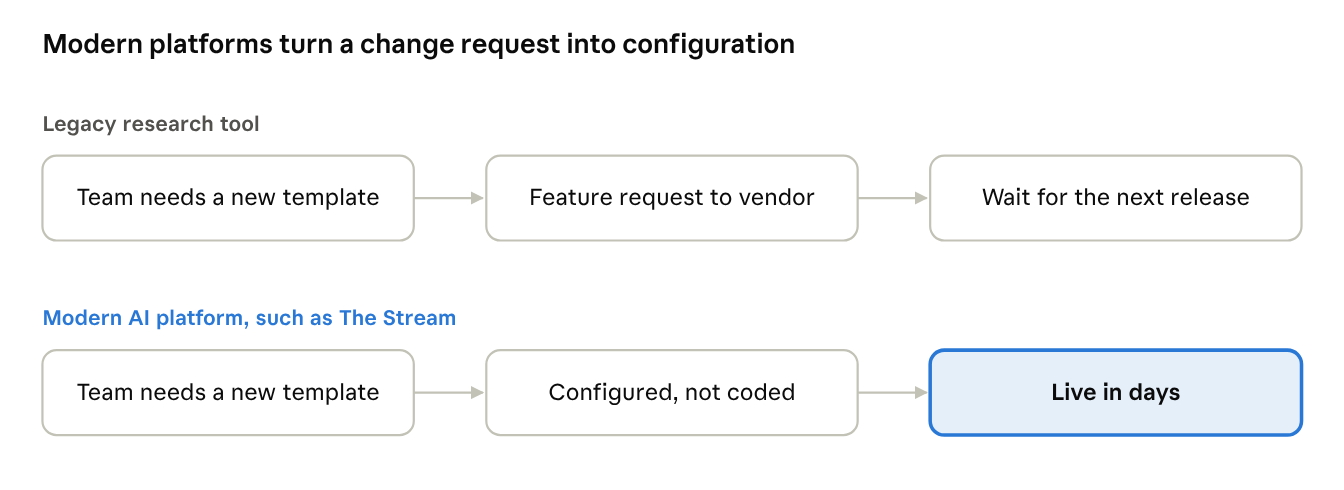
That is how The Stream works. Each team, whether equity, fund selection or ESG, gets a setup configured around its own templates, terminology and structure. The team level customisation that costs £36k to £45k per team in an internal build is part of how we work. You get the flexibility of a custom build without the cost, delay or maintenance burden.
What should investment firms build, and what should they buy?
Few firms build everything or buy everything. The usual approach is to buy the platform your research runs on, and keep engineering time for the handful of tools only your firm needs, such as proprietary quant models, alternative data pipelines or bespoke backtesting engines.
A research platform belongs on the buy side of that line because it's where your edge is created. Your analysts' thinking, judgement and conviction are what set you apart. The Stream's job is to make that thinking faster to capture, easier to find and quicker to act on:
- One home for every view. The Stream becomes your firm wide research warehouse. Every note, meeting record, investment review and DDQs sits in one searchable place, with your own systems linked in.
- AI that knows your research. Analysts can ask questions across years of the firm's own notes and get answers grounded in your house views, not generic internet content.
- Shaped around each team. Equity, fund selection and ESG teams each get their own templates, scoring frameworks and language, so the platform fits how they already work.
- Your views, in your brand. Client commentaries and reporting can be produced in your own brand, straight from the research.
What about very large firms?
Scale makes the case for The Stream stronger, not weaker. A large manager might have a dozen research teams across asset classes and regions, each working differently. Building for all of them from scratch would take years, with each team waiting its turn in the development queue. The Stream can be configured team by team in weeks, and each setup can change as that team's process does.
And remember where most of the cost sits. Industry studies put maintenance at 40% to 80% of a system's lifetime cost (O'Reilly, the 60/60 rule). Our ten year figures sit at the top of that range, because AI models, tooling and data licences need constant updating. When you buy, that upkeep is shared across every client. When you build, it's yours alone.
Build vs buy: a side‑by‑side comparison
| Four team investment manager, 60 users | Building in-house | The Stream |
|---|---|---|
| Year one cost | £416k to £503k | £85k |
| Ongoing cost per year | £124k to £161k, rising | £85k |
| Three year cost | £670k to £833k | £263k |
| Ten year cost | £1.85m to £2.36m | Around £975k |
| Risk of not delivering | High: most IT and AI projects fall short | Low: proven platform, free pilot first |
| Customisation per team | £36k to £45k each | Included |
| Migrating historical notes | £14k to £19k, built by you | Handled by The Stream |
| Internal approvals | Full review of a new internal system | Due diligence handled by The Stream |
| Time to launch | 12 months planned, around 18 typical | Weeks |
| Latest AI capabilities | Your responsibility | Included |
| Security and updates | Your responsibility | Included |
| Regulatory and audit changes | Your responsibility | Included |
| Internal resource needed | Two days a week for six months, then ongoing | Minimal |
| Key person risk | High | Low |
| Try before you commit | Not possible | Free two month pilot |
Should you build or buy an AI investment research platform?
Building your own AI research platform is possible. But for a firm with four research teams it's likely to cost over half a million pounds across three years, take a year to launch and need ongoing investment just to stand still. The same firm could run The Stream for three years for around £263k, and be live within weeks.
The smart split for most firms: buy the platform your research runs on, and build only what's truly unique to your firm.
If you're weighing up an internal build, we'd be happy to talk it through. Get in touch to book a demo or start a free two month pilot.
Figures are our estimates for a UK firm, using the median London contract rate of £550 a day from IT Jobs Watch (six months to November 2026), an internal cost of around £800 a day for investment staff, and industry maintenance benchmarks. The Stream figures are typical subscription costs for firms of this size; actual pricing depends on your setup. Your costs will vary with scope, team size and existing systems.